We went down into the cellar of wineBANK Cologne, where everything felt old. Stone, wood, and a dim yellow light that made the room seem older still. Nine glasses were waiting on the table, and that was only the first flight.
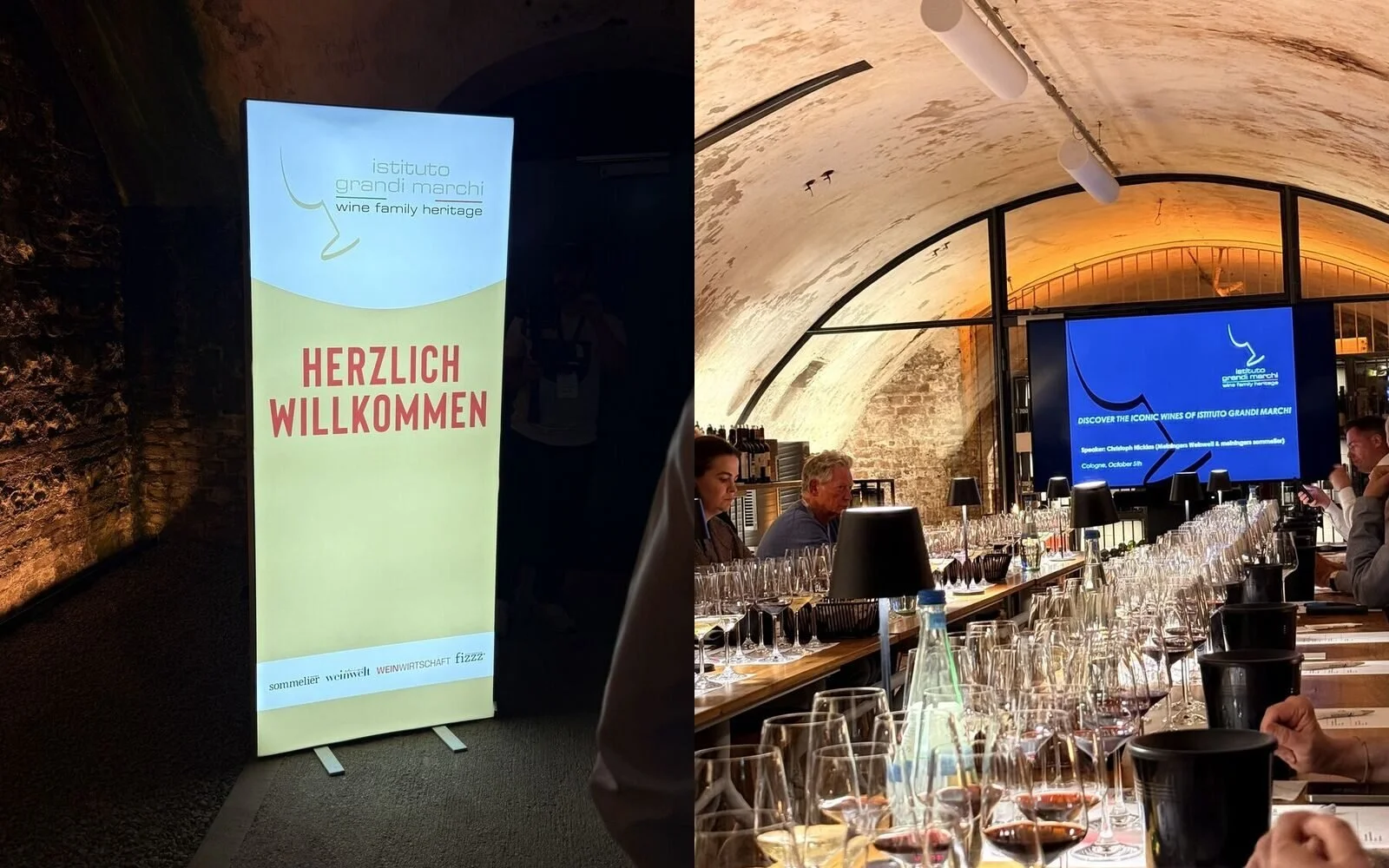
The way in: a welcome sign at the Istituto Grandi Marchi masterclass, and the vaulted cellar of wineBANK Köln set up for tasting.
I came to taste eighteen wines. What I actually tasted was eighteen versions of Italian identity, each one presented by someone from the family whose name is on the label. My tasting sheets came home covered in ticks, arrows and sentences I never finished.
The occasion was the Istituto Grandi Marchi masterclass on 5 October, hosted by Christoph Nicklas of meiningers sommelier, followed by a Grand Tasting with all eighteen houses. According to the organiser, Meininger Verlag, the families gather like this in Germany only about every four years.
Eighteen competitors, one table
Istituto Grandi Marchi, or IGM, is odd by Italian standards. Its eighteen members compete with each other every day, and still agreed to work together. Piero Antinori, its first president, once said that Italians are individualists who like doing things alone. That is why this group exists, and why it is worth a closer look.
It began in 2003, when a few producers met at a Wine Experience in New York, and became official in 2004. All eighteen are family-owned, at least 25 years old, and own their estate vineyards. Their combined turnover was about 660 million euros in 2024, with 55 percent from exports. Since 2012 they have also hosted Master of Wine candidates at their estates, a programme that paused in 2020 and restarted this year at Rivera in Puglia.
It is fair to ask where heritage ends and marketing begins. In that cellar, the families talked about their grandparents' decisions as if they had happened last year. The questions I asked about soil and climate got specific, practical answers, not slogans.
Nine glasses, then nine more
The first flight had nine wines. Then came the part nobody warns you about: before the second flight could be poured, we had to empty what was left in our glasses. It was almost painful. My head knew that nobody can drink nine glasses and then nine more, and that tasting means spitting. But each time one of these wines touched my palate, I did not want to let it go. Eighteen wines in about two hours, then eighteen producers with four or five wines each over the next three. The spittoon did a lot of work.
Meanwhile the winemakers kept arriving. One finished, and the next was already walking to the table. Nine glasses went out, nine came in. Nobody waited, nobody rushed, and the afternoon never lost its rhythm. I have been to plenty of events, and I have rarely seen anything planned so tightly.
They were also friendly and happy to answer every question. I asked about climate, soil and the choices they make in the vineyard and the cellar. In about a week I sit my WSET Level 3 exam, and Italy takes up a lot of pages in that syllabus. Hearing it from the people who make the wine is a different kind of revision.
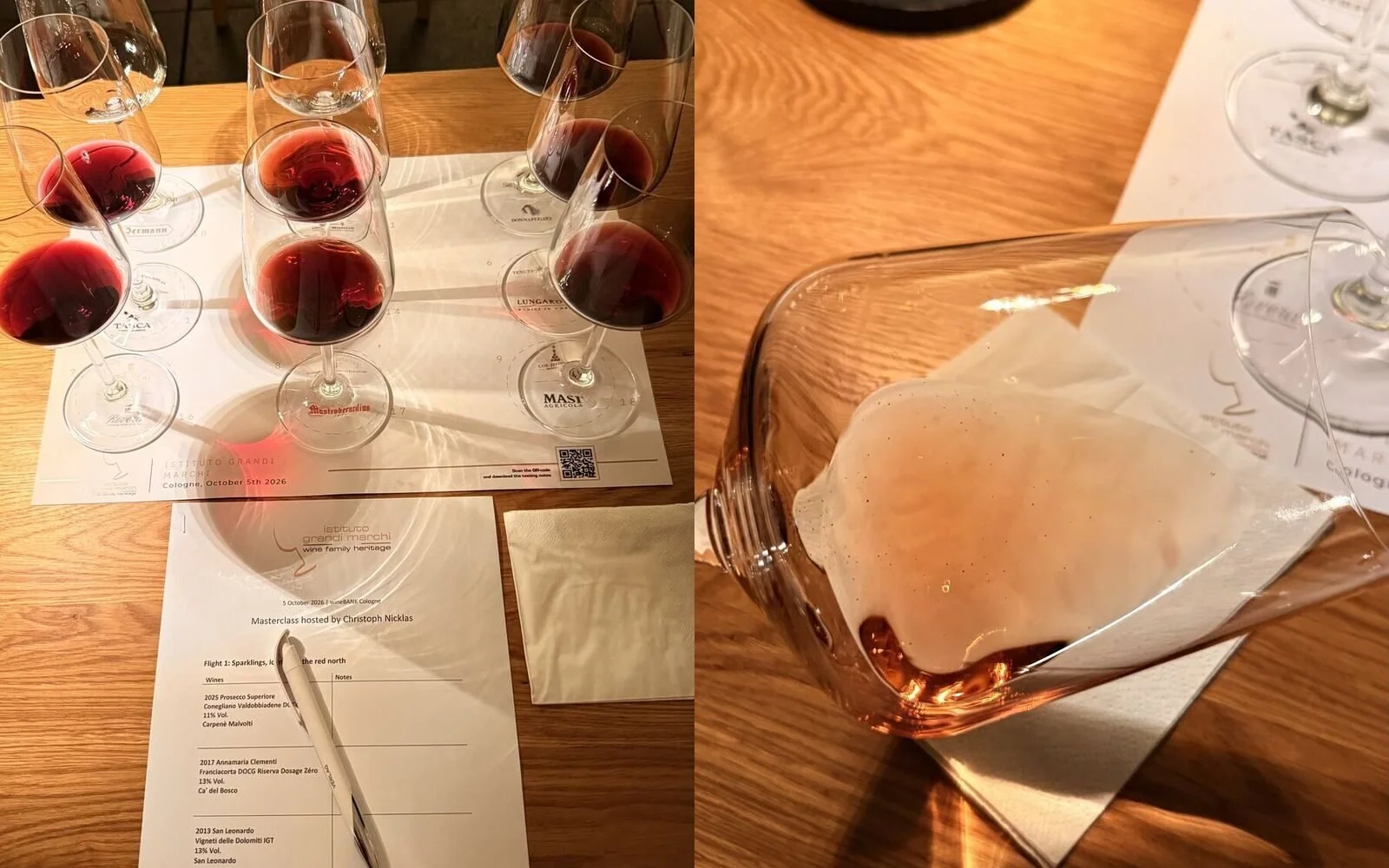
Nine glasses for the first flight
The wines that made me stop
We opened with a Carpenè Malvolti Prosecco Superiore Brut 2025. A clean, correct Prosecco, but too simple for the company it kept.
Then Ca' del Bosco, and the first tick on my sheet: Annamaria Clementi Franciacorta Riserva Dosage Zéro 2017. Golden, brioche, wet stones, a very long finish. A spring frost damaged most of the estate's vineyards that year, so there was little of it. Maurizio Zanella named the wine after his mother, who founded the estate.
San Leonardo 2013 from Trentino has the best backstory of the day. For decades the family believed an old vineyard held Cabernet Franc. After checks by Professor Attilio Scienza and the oenologist Giacomo Tachis, it turned out to be Carmenère. Fresh, a green touch, balsamic notes. One line from the presentation went straight into my notes: elegance is not about being noticed, but about being remembered.
Sassicaia, four times
Sassicaia ran through the whole afternoon, and I tasted four vintages: 2012, 2013, 2015 and 2022.
Mario Incisa della Rocchetta, a Piedmontese aristocrat who came to Tuscany through marriage, planted Cabernet Sauvignon in Bolgheri in the 1940s because he loved Bordeaux. For years he made it for family and friends. My notes say just that: between Piemonte and Toscana, a wine for friends. The first commercial vintage was 1968, the year Giacomo Tachis started working on it.
Four vintages, four kinds of weather. 2012 ripened early, and critics argued about it. 2013 was calm and balanced, and the family calls it a record vintage. 2015 was our masterclass wine, warm, bolder and riper than usual, named the best wine in the world by Wine Spectator in 2018. 2022 was hot and dry, and Carlo Paoli, the general manager, compared the young wine to a kid with a drum kit. What I underlined in my notes on 2015 was three words: stay and not change. Whatever the year, Sassicaia stays itself.
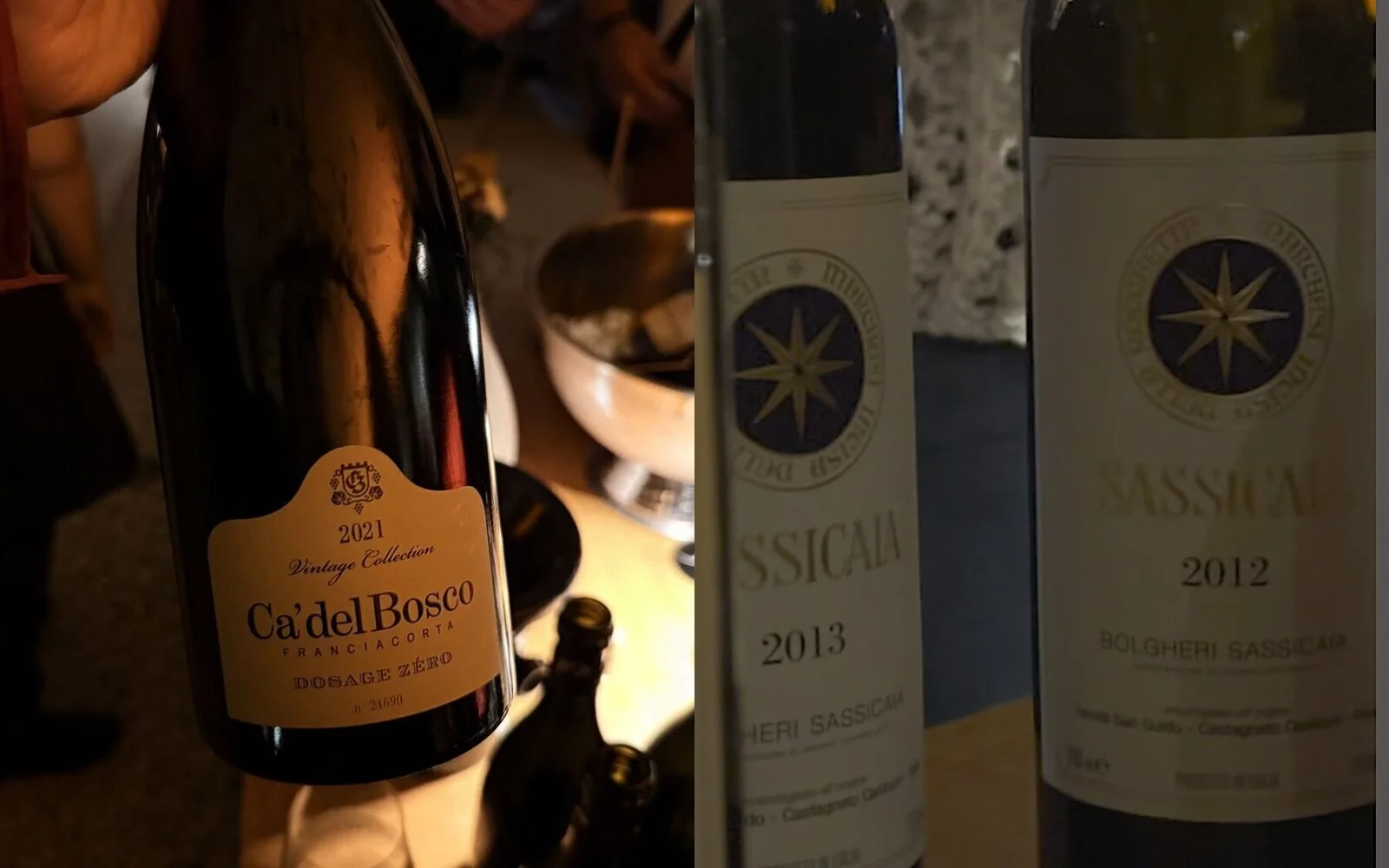
Ca' del Bosco Dosage Zéro, and two of the four Sassicaia vintages on the table: 2012 and 2013.
A short history of rebels
Sassicaia matters because the Tuscan wines in the room all come from the same story. In the 1960s and 70s the appellation rules did not leave much room for the serious red some families wanted to make, so they made it anyway and labelled it simple table wine. In 1978 the 1972 Sassicaia came first in a blind tasting in London against 33 Cabernets from around the world. Antinori's Tignanello arrived in the early 1970s, and Italy created the IGT category in 1992 partly because so many of the best wines were sitting outside the system. The press gave the movement its name: Super Tuscan.
Giovanni Folonari told us that his family counts among the pioneers, and Cabreo Il Borgo, first made in 1982, fits that. Another tick from me. Nicolò Antinori, the 27th generation of a family that has made wine since 1385, presented Guado al Tasso 2023.
Three whites to remember
Umani Ronchi's Historical Vecchie Vigne 2020, a Verdicchio dei Castelli di Jesi, tasted as if it had spent time in oak. It never did. The representative from the winery explained that the impression comes from very high concentration and extremely old vines, more than fifty years old. I put my glass down and wrote that sentence in my notes.
Jermann's W...Dreams 2023 came from Friuli, near the Slovenian border, from a family that arrived from Austria in 1881. Smoke, pineapple, stone fruit, a mineral spine. Donnafugata's Sul Vulcano Etna Bianco 2021 was young and fruity, and the family is known for artistic labels, including a collaboration with Dolce & Gabbana.
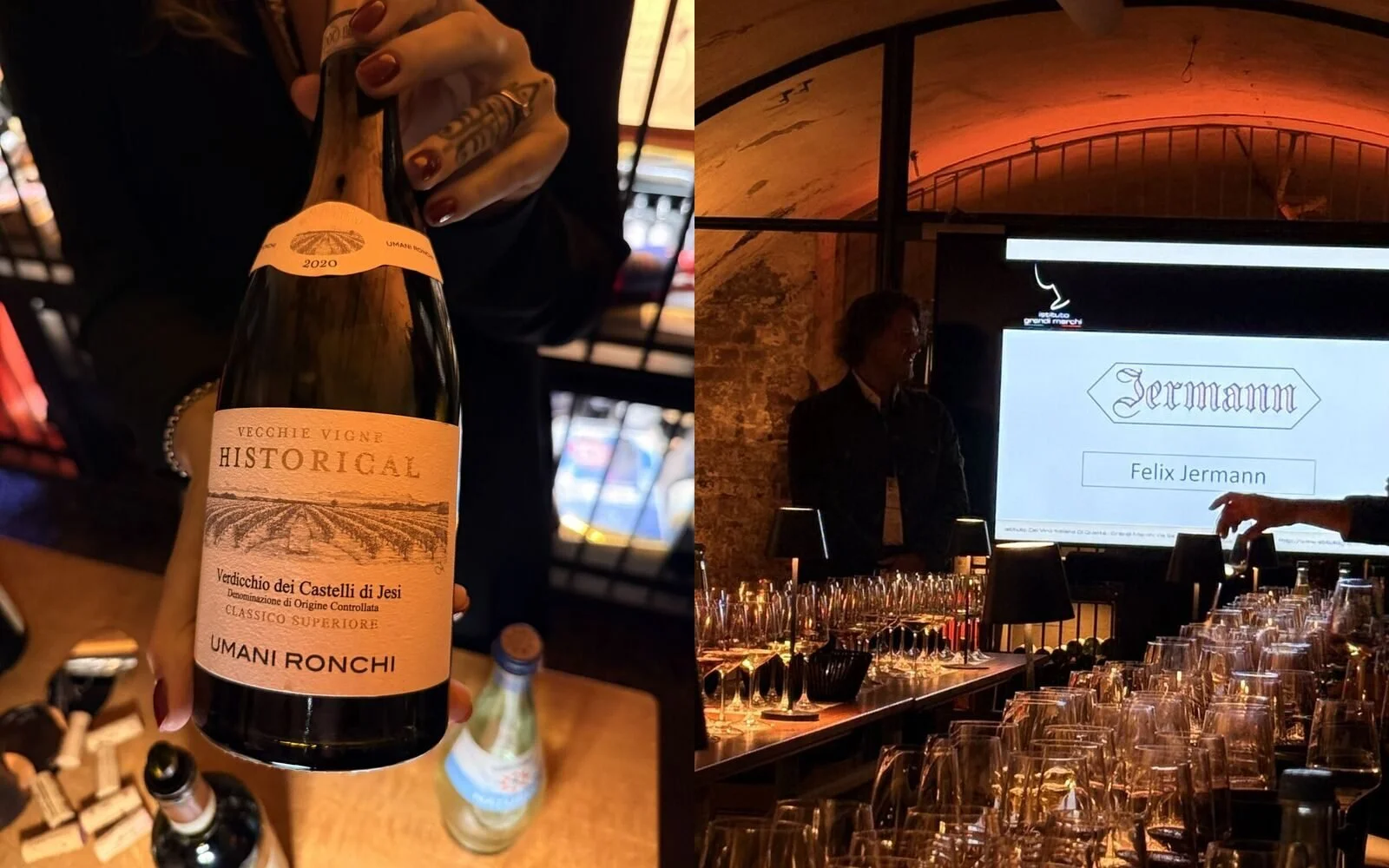
Umani Ronchi Historical Vecchie Vigne 2020, the Verdicchio that tasted of oak without ever seeing it, and Felix Jermann presenting from Friuli.
South, and then Sardinia
A great Italian red does not have to use international grapes, and Argiolas Turriga 2022 makes that point without raising its voice. It is built on Cannonau, which is Grenache, with Carignano, Bovale Sardo and Malvasia Nera. Tachis helped create it, and the first vintage was 1988. Cherry, small sour cherry, extremely long maturation, a wine made for food. For me, the Sardinian wine was the star.
Mastroberardino's Radici Taurasi Riserva 2016 earned my last big tick: Aglianico from high Campanian hills, cherry, violets, high acidity. We were told these wines can age for up to a hundred years. I can't verify that, but it says a lot about how the family sees its own wine.
Masi closed the line-up with Costasera Amarone Riserva 2019, presented by Alessandra Boscaini. Big and disciplined. Afterwards, at the Masi stand, I tried Conte Federico Riserva Brut 2021, a Trentodoc from Conti Bossi Fedrigotti, an estate that has belonged to the Masi group since 2007. Chardonnay and Pinot Nero, about 40 months on the lees. Bright structure, lifted aromatics, everything I want from a good Trentodoc.
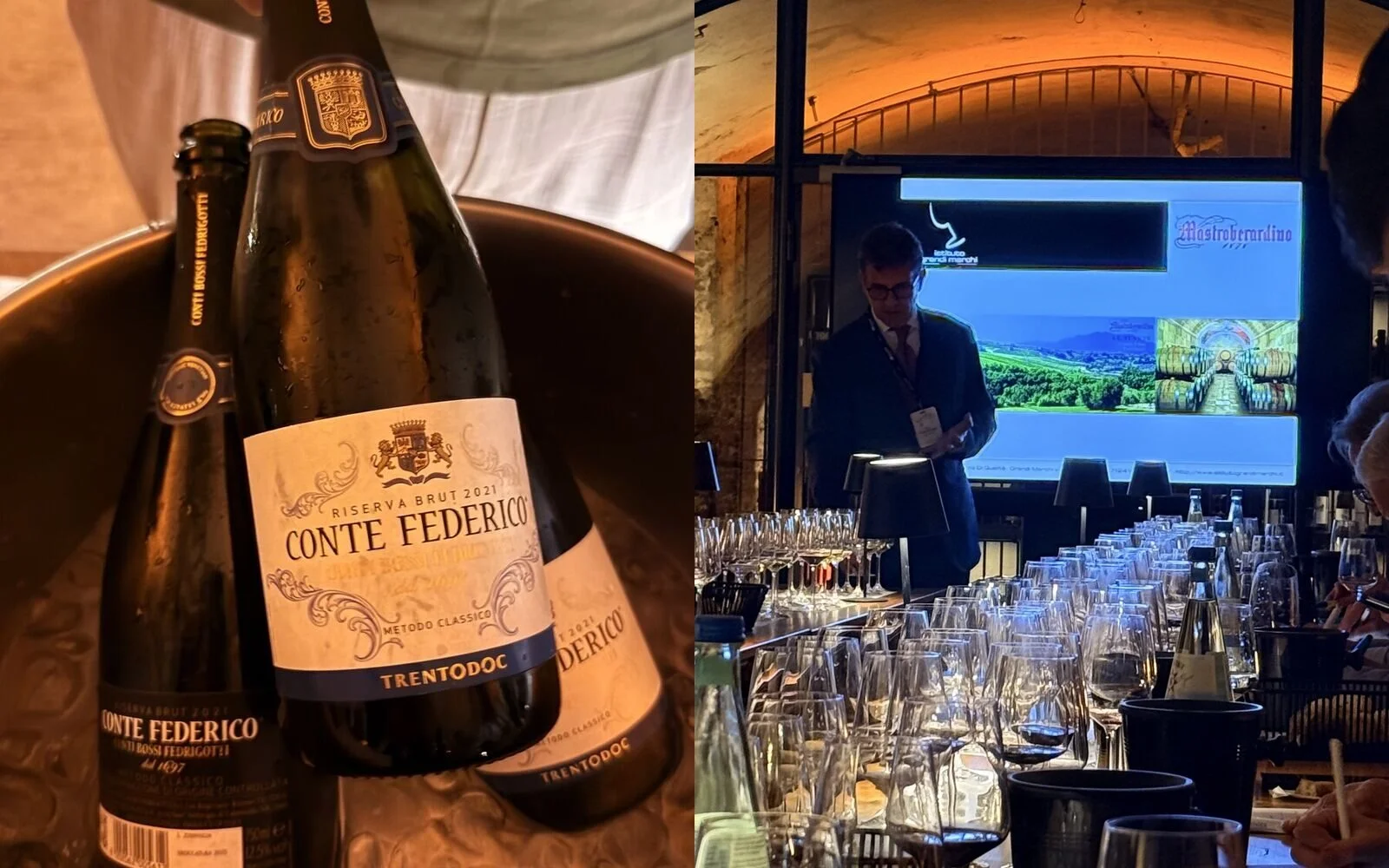
Conte Federico Riserva Brut 2021, the Trentodoc from the Masi stand, and Mastroberardino presenting the Taurasi.
After the masterclass
After the masterclass came the Grand Tasting, where each producer poured four or five more wines and we could talk to them in person. A wine you tried in a glass becomes a different thing once the person who made it tells you why.
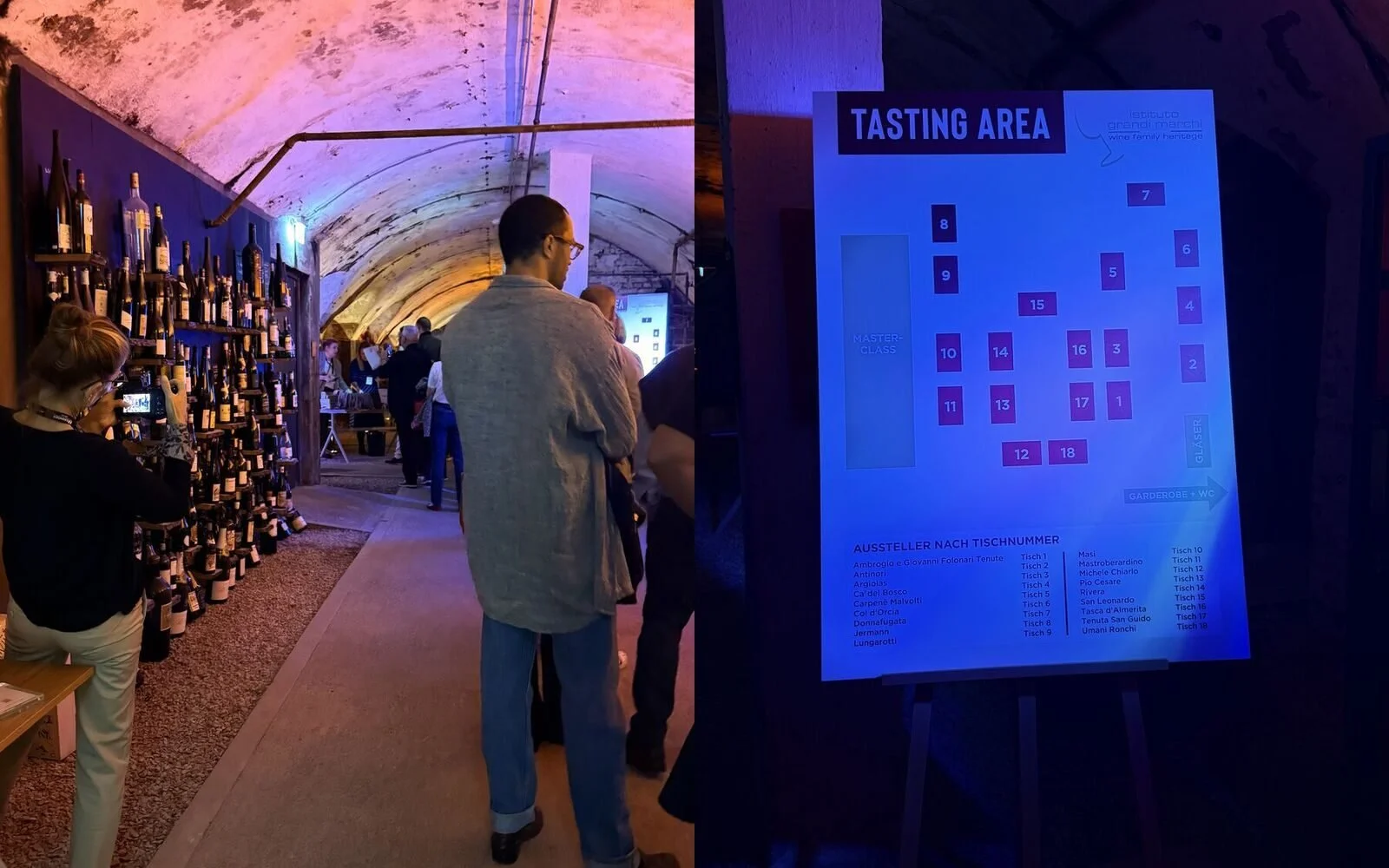
The Grand Tasting: eighteen producer tables spread through the cellar corridors of wineBANK Köln.
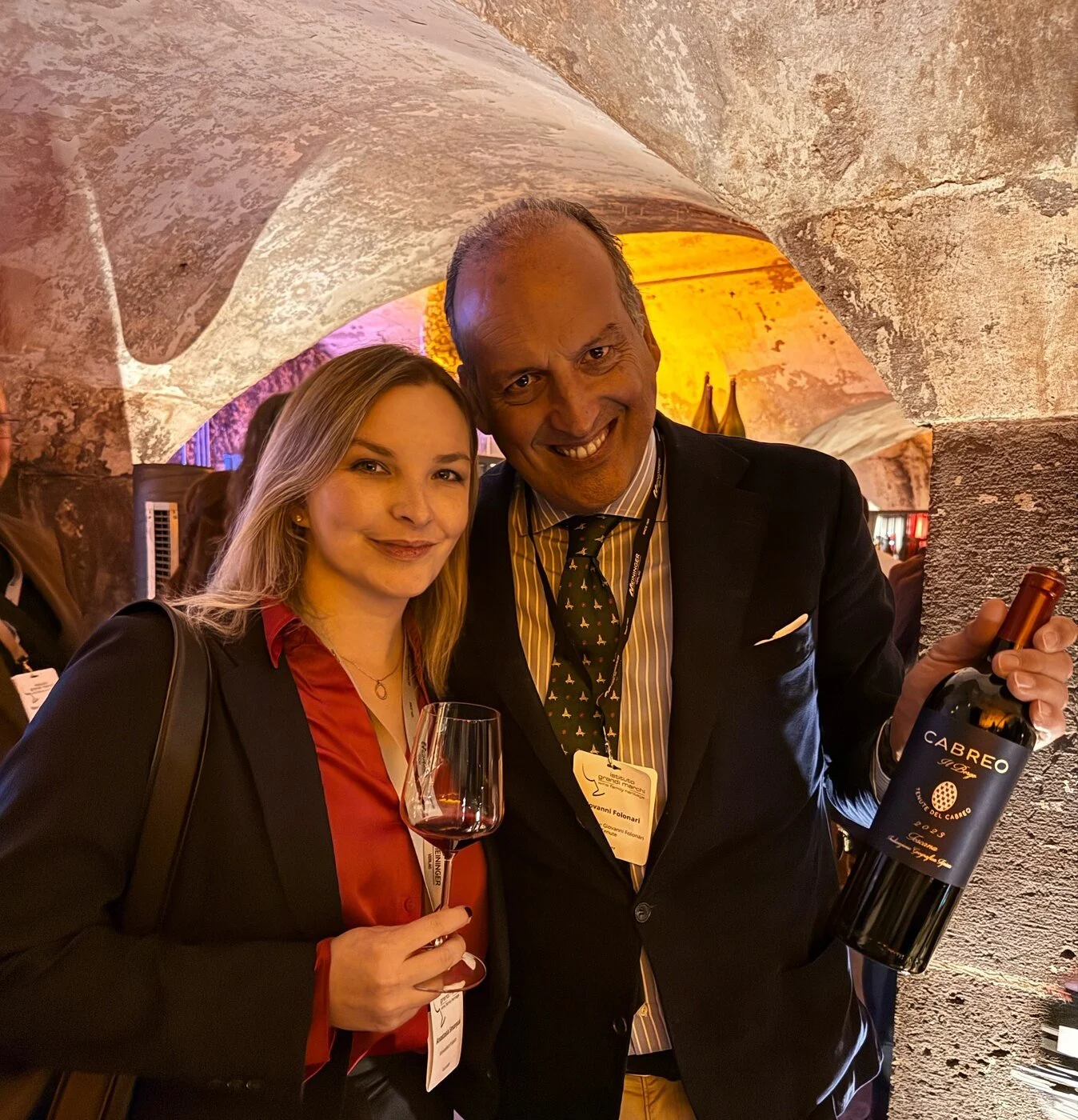
Me with Giovanni Folonari and his Cabreo Il Borgo 2023.
What I took home
I did not see all of Italy in those glasses. I saw the Italy that its most established families want the world to remember, and that version alone was remarkably varied. Eighteen competitors share a stage, and every wine looks better for it.
Anastasia Smanyuk, Winetellect Projects
Thank you to the people who made it possible for me to attend this event: Istituto Grandi Marchi, Meininger Verlag, wineBANK Köln, and our host Christoph Nicklas of meiningers sommelier. And to all eighteen families who came to Cologne to pour their own wines: Carpenè Malvolti, Ca' del Bosco, Jermann, Umani Ronchi, Tenuta San Leonardo, Masi, Pio Cesare, Michele Chiarlo, Antinori, Ambrogio e Giovanni Folonari Tenute, Tenuta San Guido, Col d'Orcia, Lungarotti, Mastroberardino, Rivera, Argiolas, Tasca d'Almerita and Donnafugata.
Sources: Istituto Grandi Marchi (istitutograndimarchi.it); Meininger Verlag event pages (meininger.de); WineNews and Vinetur on IGM and its Master of Wine programme; Gambero Rosso International and Decanter on Sassicaia; producer technical sheets from the event.
Keep exploring
Wine vocabulary still feeling like a second language? Try the Wine Language Master Glossary or browse the glossary.
